

Skip to content

The intelligence layer for space companies

Live mission assurance for satellite and space companies.

Keep the operational and reliability cases live, on the telemetry you already downlink.

Runs alongside your mission control system, cloud or on-prem. No re-architecture.

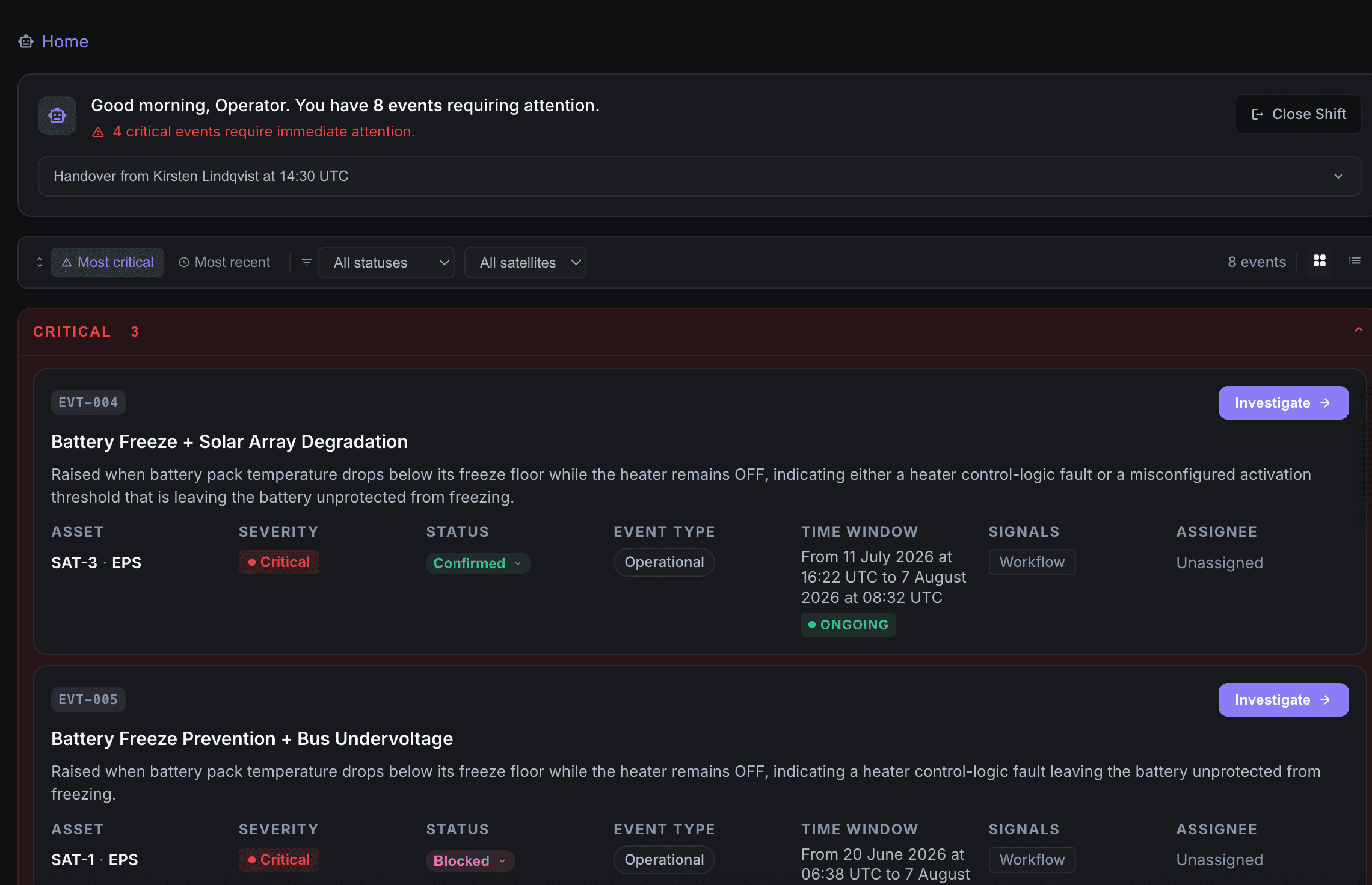
  • app.intella.tech/fleet

    The Mercury fleet overview, with every spacecraft, its status and the events open against it.
    01Fleet overviewEvery spacecraft, its status, and what is open against it.
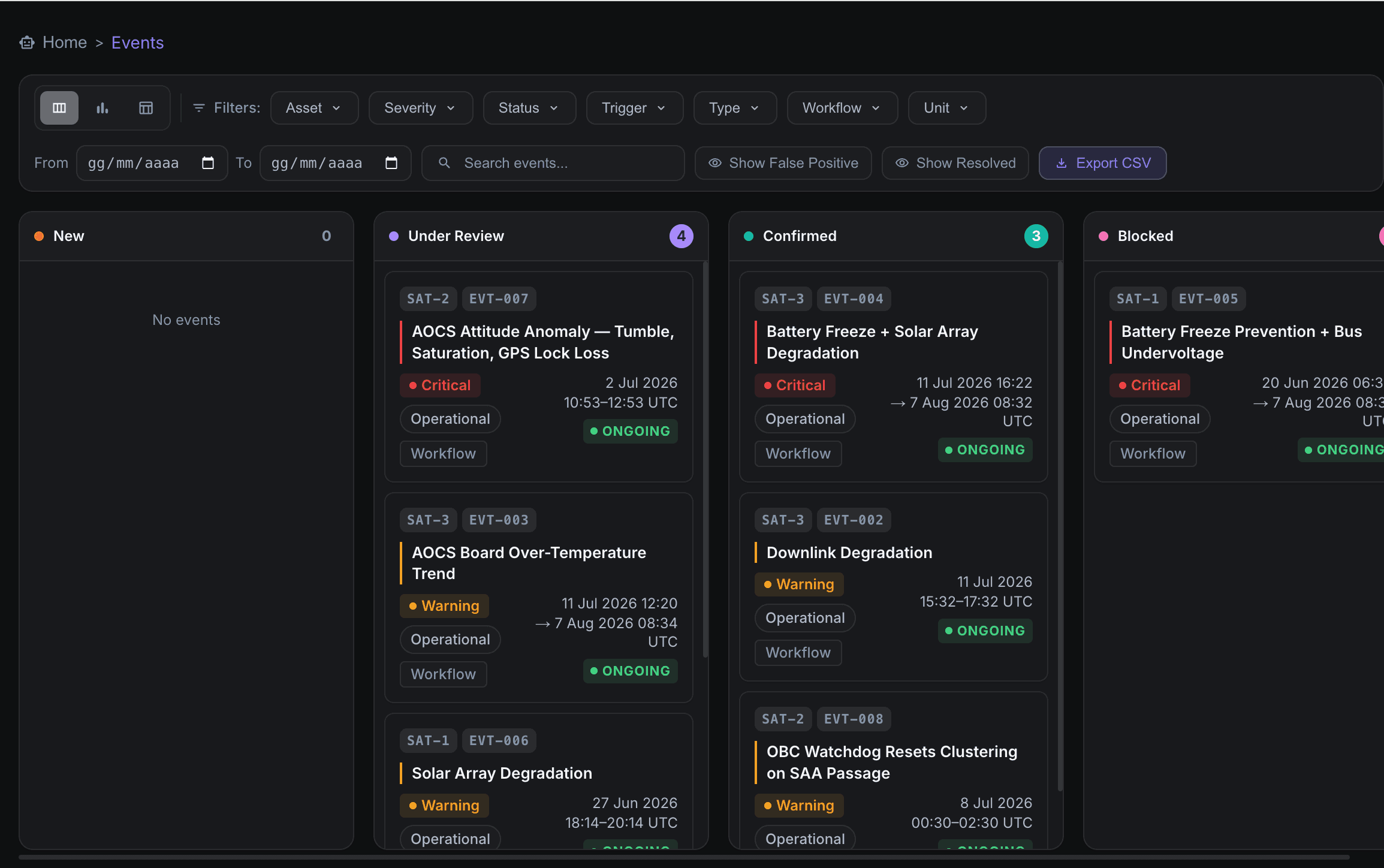
  • app.intella.tech/events

    The Mercury events board, with qualified events for three spacecraft grouped by workflow status.
    02Events boardQualified events, ranked, owned and grouped by status.
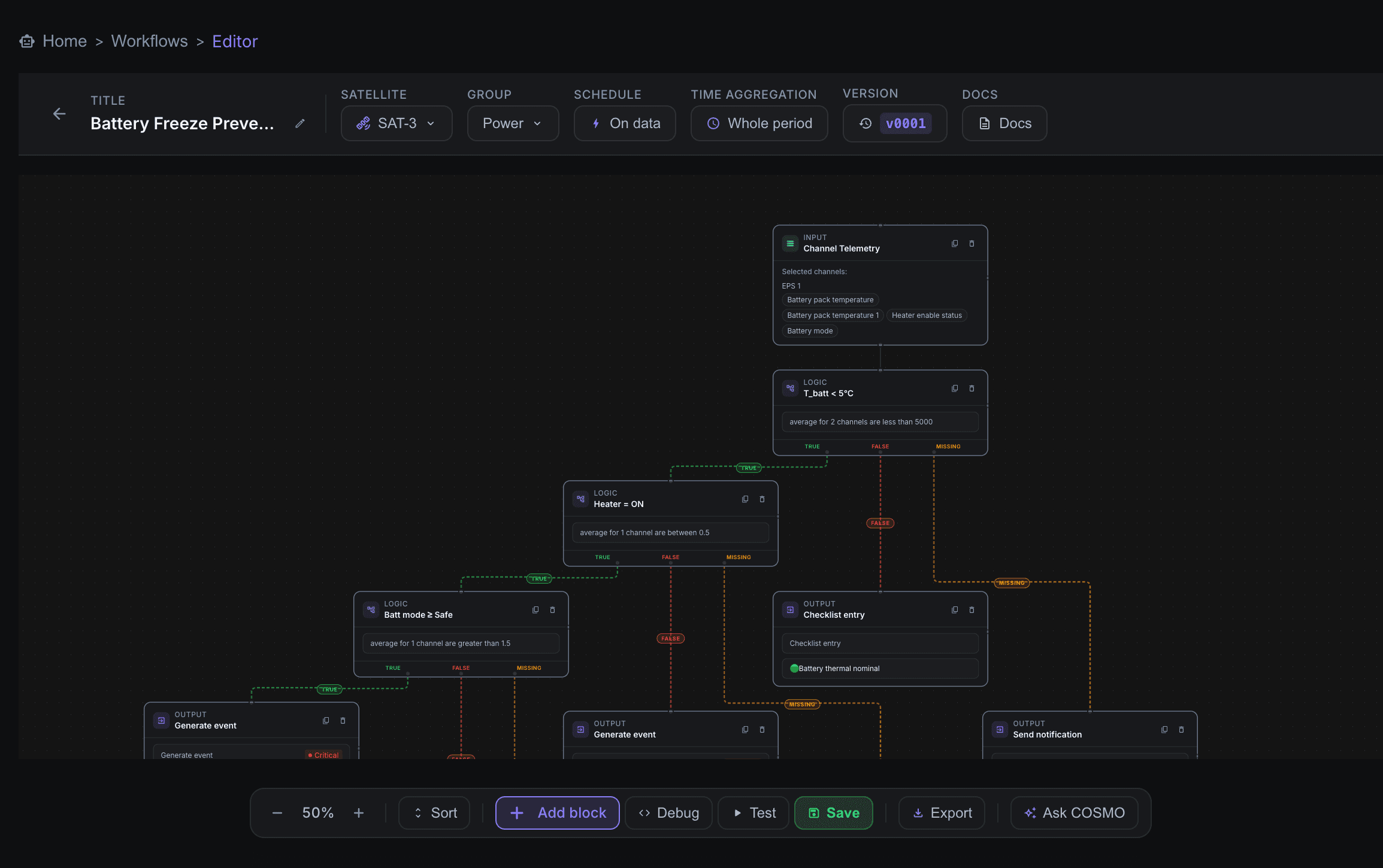
  • app.intella.tech/workflows

    A Mercury workflow, with the conditions that fire it and the recommended action it produces.
    03WorkflowsYour procedures, running. Edited without code, under approval.
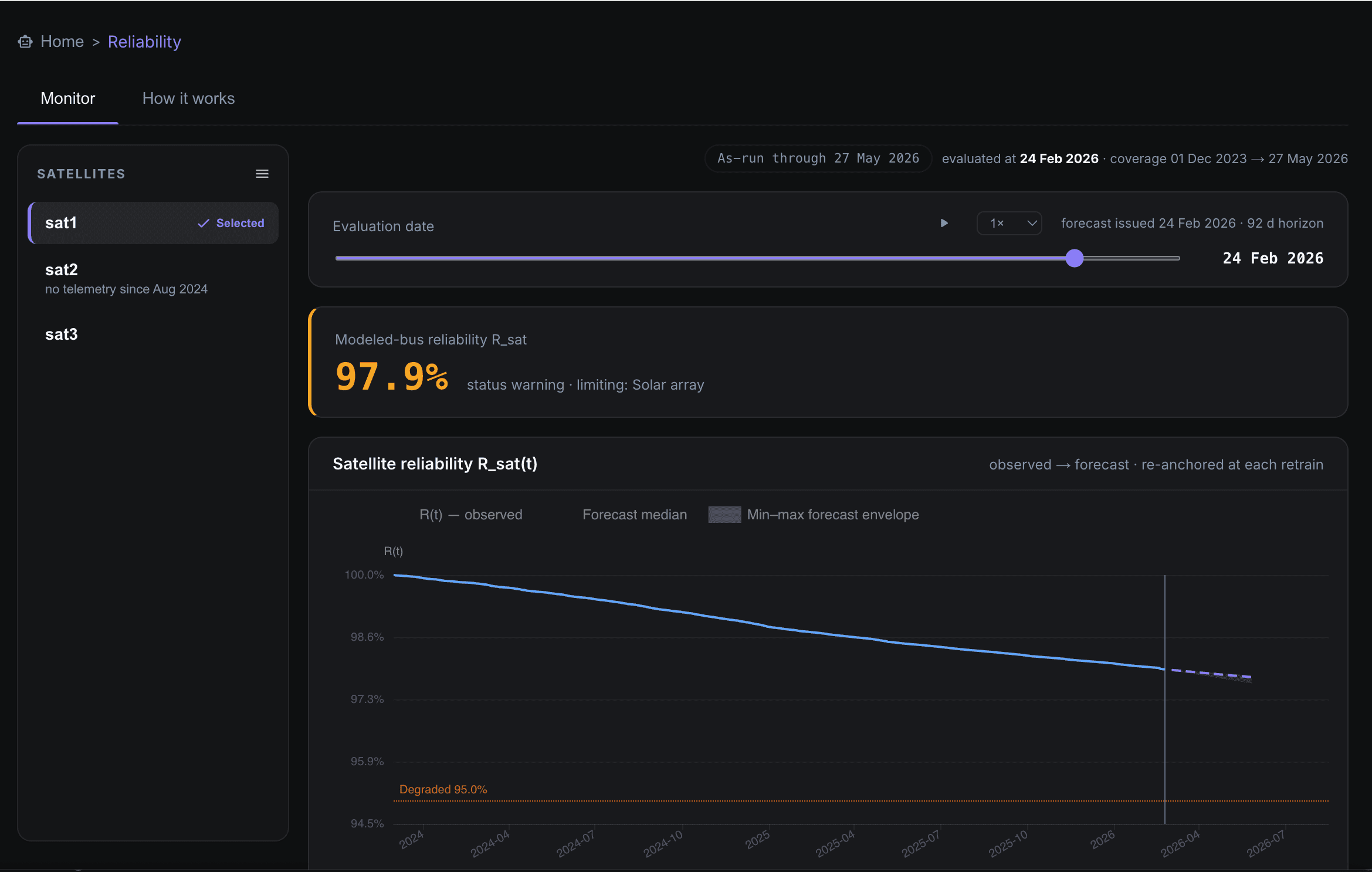
  • app.intella.tech/reliability

    Hydra tracking modelled bus reliability against its degraded floor, with a forecast envelope and per-component figures.
    04Reliability and remaining lifePer-component reliability, recomputed from flight evidence.

01Mission statement

Mission assurance is proved once, before launch, against expectations.

We keep both cases live through the mission, reading the telemetry you already downlink through physics modeling, advanced deterministic logic, and AI.

Where this goes

Mission assurance is the beginning. Every qualified event and every reliability estimate is structured evidence, and evidence compounds: backward into how the next spacecraft is designed and tested, forward into how much of the routine a fleet can safely delegate.

We are building the intelligence layer for the space economy.

Trusted by

  • D-Orbit
  • Telespazio

02What challenges we address

You fly against two cases. Both were written on the ground.

  • The operational case

    01

    The ops team becomes the ceiling.

    Procedures, limits, contingency trees and escalation paths, written for a satellite nobody had flown yet. Kept current by hand, they are only ever as current as the last person who had time to update them.

    Every satellite you add multiplies the routine. And the routine grows even when the fleet does not: conjunction screening, deconfliction and reporting scale with the orbital environment, not with your fleet plan. The team absorbs it until it cannot, and the first thing to suffer is the rare event that actually matters.

    Response slows. Escalation depends on who is on shift. Growth turns into a hiring problem, and the fleet plan starts waiting on the ops rota. You find out where the limit is during an incident, against an SLA.

  • The reliability case

    02

    The end date on the spec sheet is not the real end date.

    Failure rates, redundancy, design life and disposal margin, fixed at design review against duty cycles no real spacecraft actually flies.

    Extend or retire is one of the most expensive decisions in the fleet, and it is based on numbers fixed before launch. The difference between the spec-sheet date and the real one is worth money in both directions. Retire early, and you discard capability you already paid for. Fly too long, and the asset fails in service, or loses the ability to deorbit at all.

    Under ISO 24113 and, for US-licensed operators, the FCC five-year rule, that is a compliance exposure, not only an engineering one. The tool produces the evidence, the operator makes the call.

Neither case maintains itself. Both are maintained by people, one event and one review at a time, and neither shows up as a failure until it is one.

03Our software solutions

Mercury

Your operational case, kept live.

Operational assurance today is mostly reactive: it starts when something goes wrong. Mercury makes it continuous.

It knows what intended means from your own procedures, it notices the ways reality departs from it, and it turns that into qualified events with a recommended action. Your engineers get a decision to make, not an investigation to run, and the same team runs a bigger fleet.

Mercury is where your operational case runs. It takes multiple signals, including satellite telemetry from your MCS, per-component degradation signals, and AI detection, and correlates them to spot relevant operational events and inform your ops team. Events follow your procedures. Mercury recommends and hands off. Your team decides.

It runs alongside your mission control system. No re-architecture, no replacement of existing tools, no disruption to live operations.

Hydra

Your reliability case, kept live.

Monitoring tells you the battery is fine today. Hydra tells you how much of it is left.

It turns telemetry into per-component remaining useful life and forecast reliability, so the question stops being what the spec says and becomes what the evidence says is actually left, and whether it is worth acting on. Extend usable life where it is there. Retire on evidence, not assumptions.

Hydra reads the stress each component has absorbed in flight and continuously recomputes reliability, then forecasts when it will cross the line. The number traces to known failure physics, not a black box, so you can defend the disposal decision.

It starts from your own qualified design baseline and rolls up through your own redundancy scheme, so it collapses to your numbers when the vehicle is flown as designed, and diverges only as measured stress departs from it.

Useful life is an assumption carried on your balance sheet. Flight evidence is what lets you revise it, and defend the revision. Hydra produces the evidence. Your team makes the call.

Three signals. Your procedures. One operational case, kept live.

Physics-based degradation modeling reports what is wearing out. Advanced deterministic logic encodes what you already know. AI detection flags what no rule anticipated. Three ways reality departs from intent. What makes them a decision is your own conops, running as logic on every pass: Mercury correlates the signals against it and returns one qualified event with the procedure to apply. Every event and every action stays as a record, so the operational case is current rather than reconstructed for a review.

Run Mercury and Hydra together, or start with one.

04Trust and security

  • Runs inside your perimeter

    Your cloud or on-prem, on your infrastructure. Telemetry and events stay under your control. Nothing is required to leave your environment for the software to work.

  • Nothing changes on the spacecraft

    No new sensors, no flight software changes, no change to how you fly. Mercury and Hydra run on the housekeeping telemetry you already downlink, alongside the mission control system you already use.

  • Every number traces to a cause

    Model parameters are exposed and editable. Defaults trace to a recognized standard or to in-orbit calibration. No hidden constants, and nothing you cannot defend in a review.

  • Built for audit

    Every event, action and workflow change is versioned and attributable, with approval flows and a full audit trail. SSO through your identity provider and role-based access.

We work with commercial operators flying growing fleets with lean operations teams, in LEO and GEO.

05Two questions worth asking

  1. Can your team absorb the next ten satellites?
  2. Do you know what life is actually left in the ones you already fly, and what that is worth?

If either answer is uncomfortable, we should talk.

Ask for a demo

A person reads every message. We reply within two working days.